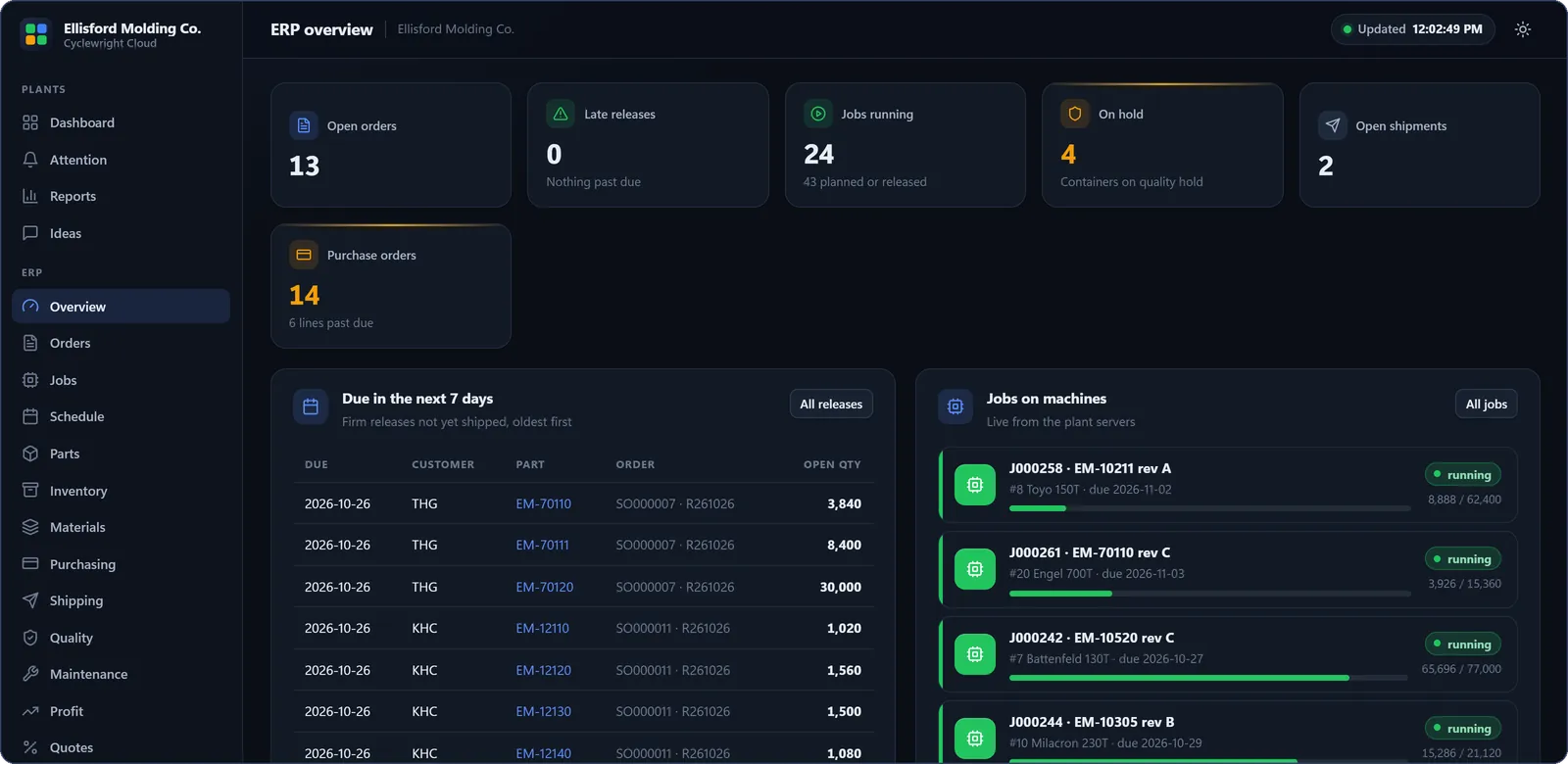
Built around how molders work
| Area | What's included |
|---|---|
| Sales | Customers and ship-tos, blanket and spot orders, firm and forecast releases. EDI 830, 862, 850 and 860 in. |
| Engineering | Parts (manufactured, subassembly, purchased, resin, colorant, insert, packaging), bills of material with regrind percentage, routings, control plans, and tooling with parts per cycle. |
| Production | Jobs sent to machines. Good and scrap counts arrive live from the plant floor. A scheduling board timed from live cycles. |
| Inventory | Locations, labeled containers with serials and a full ledger: pack, receive, move, hold, release, adjust, scrap. Material loaded to jobs and backflushed. |
| Purchasing | Suppliers with prices, minimums, multiples and lead times. Purchase orders received into labeled containers with the supplier's lot. |
| Materials | MRP from releases, orders, jobs, stock and open POs: multi-level, time-phased, with safety stock. Buy suggestions become draft POs in one click. |
| Quality | Control plans, inspections, nonconformances (NCRs) and SPC. Checks come due from live production; a failed check holds the suspect containers. A quality system for ISO 9001 and IATF 16949 audits: documents, training, calibration, audits, 8D corrective actions, PPAP, PFMEA and traceability. |
| Labels | A label designer with customer formats (GM, Ford, Stellantis, Honda, Nissan and more), pallet master labels and retailers' GS1-128 labels. Labels print at the press from live data, with scan-to-verify and Honda L-MPR label controls. |
| Maintenance | PM plans for tools and machines, due from live shots, run hours or days. Work orders with checklists. |
| Shipping | Shipments built by scanning container labels; releases filled oldest-due first. ASNs and invoices out by EDI. |
| Costing | Live profit per press, job profit so far, and a quote calculator. |
| Integration | A REST API for everything with per-company API keys; QuickBooks Online and Xero sync. |
| Users | Unlimited, with roles that set what each person can see and change. |
How production gets into the ERP
- A job is sent from the ERP to a machine. The tile on the board shows it.
- The plant server tags every cycle and reject with that job number.
- Each sync, every 5 to 15 seconds, updates the job's good and scrap quantities.
- Schedules, quality checks due and maintenance due follow on their own.
The cloud only changes a machine's job details. Wiring, interlock rules and outputs are never touched from the cloud.
Scheduling from real cycle times
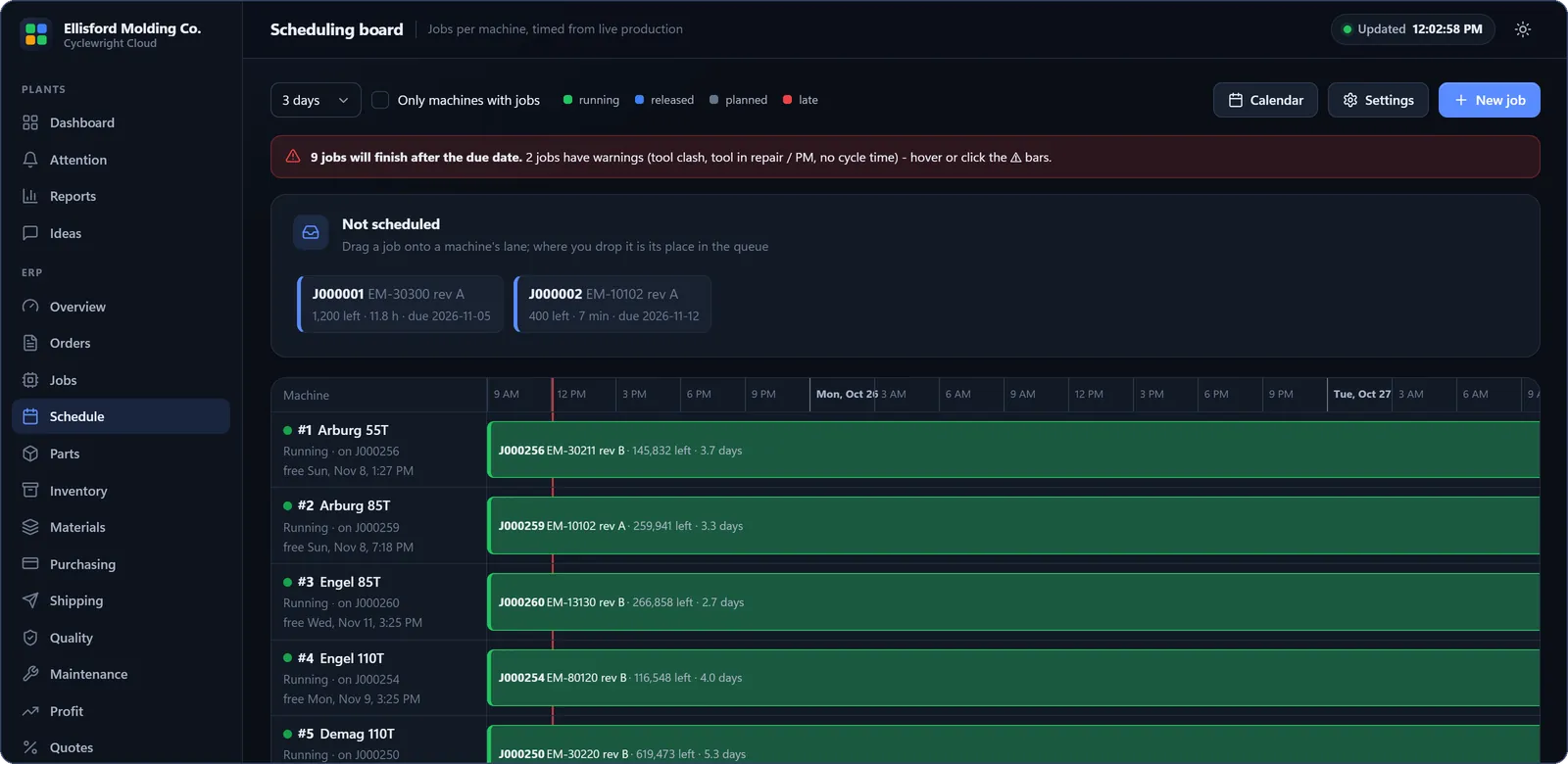
The drag-and-drop scheduling board times every machine's queue from live production, so each job ends when the press will really finish. It knows holidays, planned downtime and overtime, and warns about tool clashes, tools in repair or PM, and jobs that will finish after their due date.
Labels, shipping and EDI
Container labels print at the press, from live data, the moment a container is packed. The label designer starts from customer formats (GM, Ford, Stellantis, Honda, Nissan and more), pallet master labels and retailers' GS1-128 labels with the SSCC. Shipments are built by scanning those labels, and the ASN lists each container's label serial so the customer's scan matches. More about EDI.
For customers who ask for it, every label is scanned once it is on the container, and nothing ships until every label on the load is scanned. Honda suppliers get the stricter L-MPR label controls: one label at a time at the press, supervisor-approved reprints, a mold check and line clearance at every job change, and IPP tags.
Profit per press, per hour
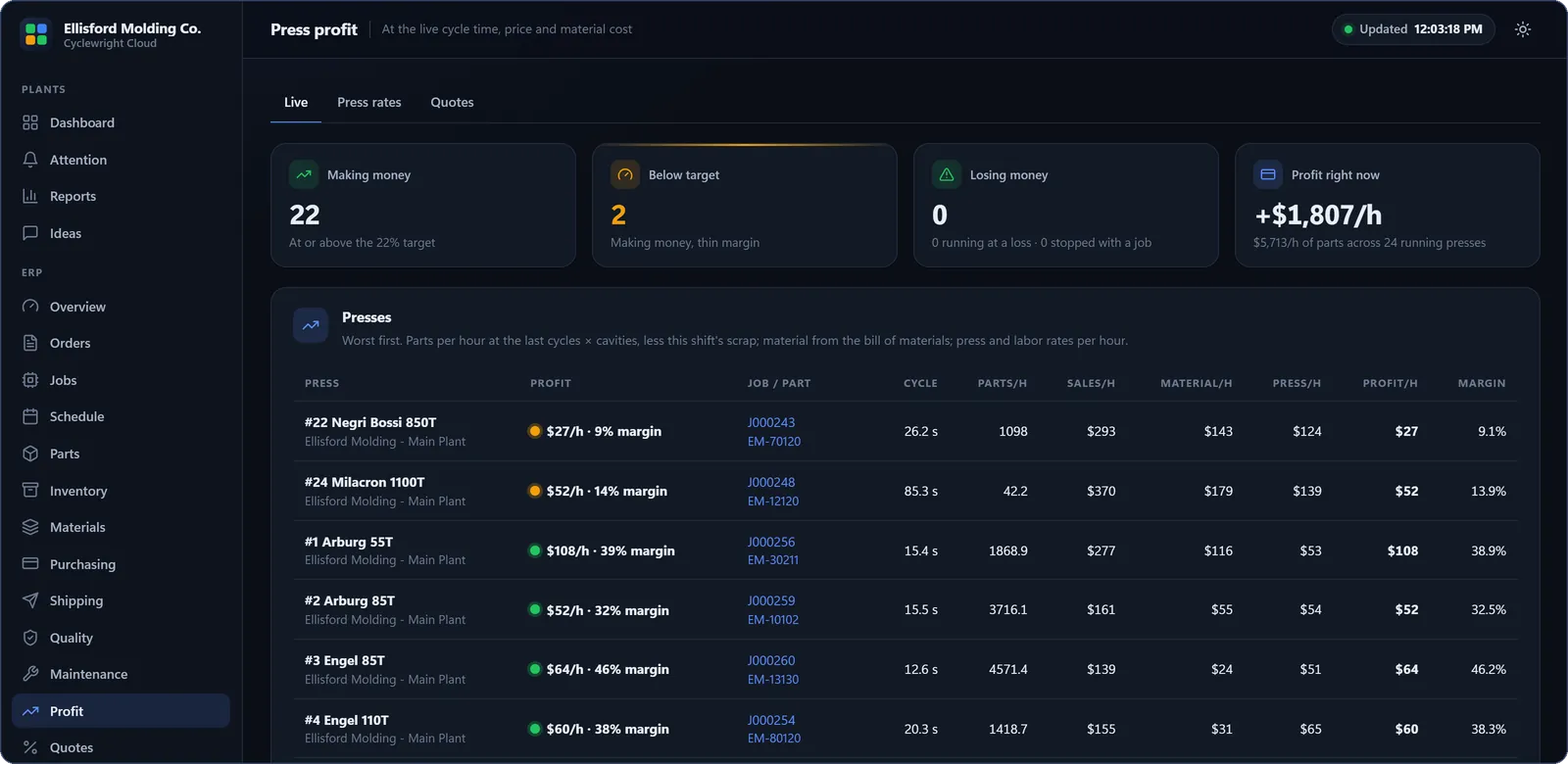
Every running press gets a live flag (green, amber or red) from its real cycle, cavities, price, the material on the bill of materials, and the press's hourly rate. Jobs show profit so far, and the quote calculator uses the same rates; a won quote sets the part price.
Quality and maintenance
Checks come due from each job's control plan and its live part count. Scale weights go straight into SPC. NCRs and work orders can carry photos from the floor. Preventive maintenance is due from tool shots and machine run hours.
The quality system keeps the records ISO 9001 and IATF 16949 auditors ask to see (documents, training, calibration, audits, corrective actions, PPAP and traceability), next to the production data they come from.
Accounting and the data you already have
Shipped shipments become invoices in QuickBooks Online or Xero, with paid status read back, or export as IIF or CSV files. The import reads exports from Plex, DELMIAworks (IQMS), Epicor and other ERPs or any spreadsheet, with a preview before anything changes and an undo, and the REST API covers everything else. How switching works.
Plants, users and change history
One ERP covers every plant, with unlimited users. Viewers read, supervisors create and change, admins delete. Every change to every record is kept in its change history: who made it, when, and the value before and after. Every record is scoped to its company.